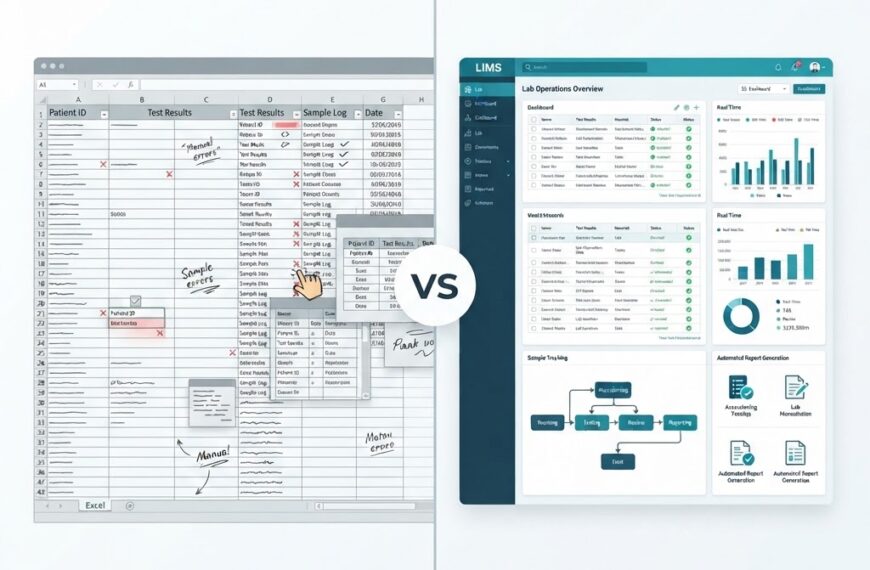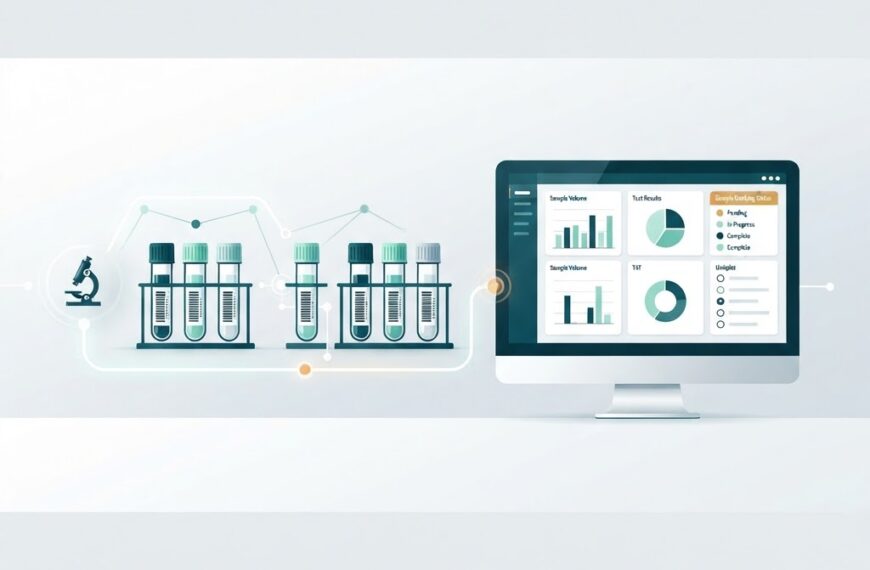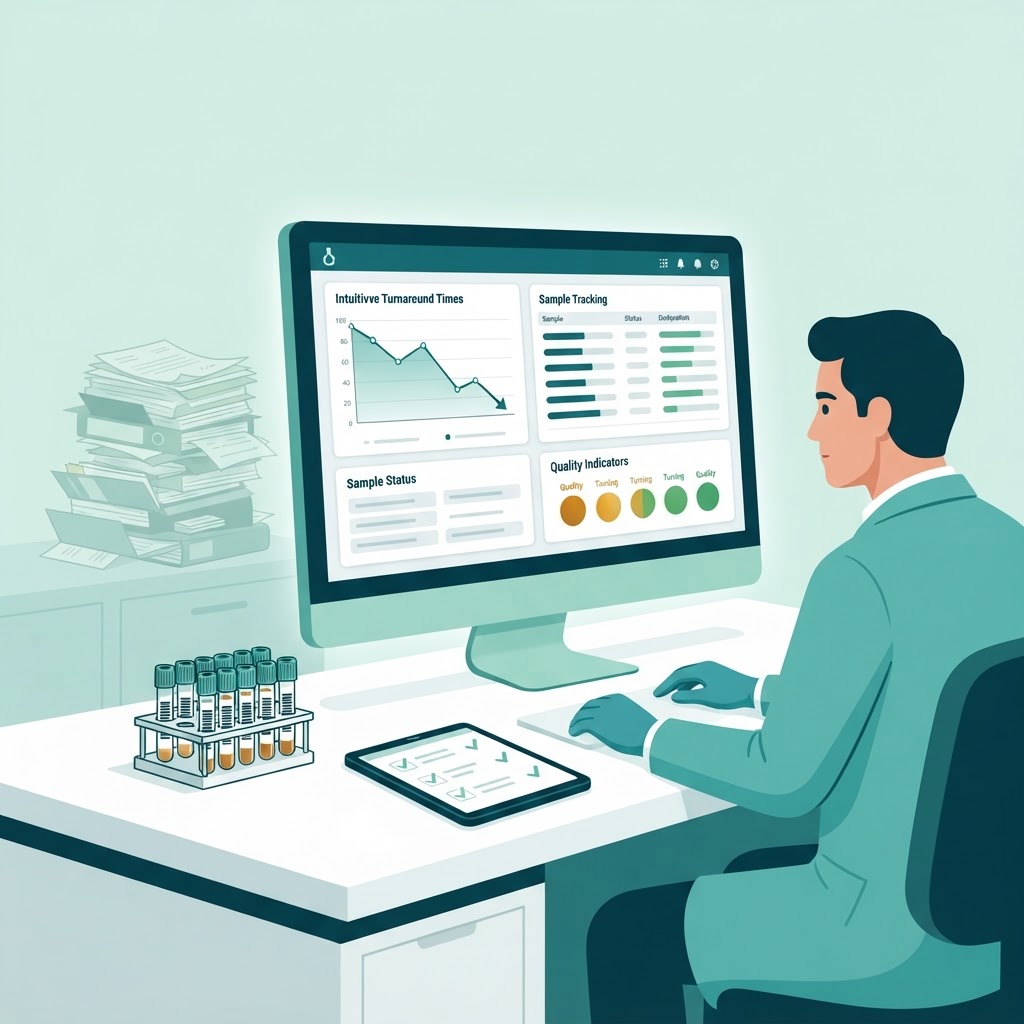

When a diagnostic laboratory moves from manual processes — or a patchwork of spreadsheets — to a dedicated Laboratory Information Management System, the change is not just about digitising paperwork. It touches every part of the lab’s daily operation, from the moment a sample arrives to the moment a report reaches a patient’s doctor. This article looks at the concrete, observable benefits of LIMS software for pathology labs, based on what labs actually experience after implementation.
If you are new to LIMS concepts, our earlier piece on what LIMS is and the comparison between LIMS and Excel provide useful background.
What Changes on Day One
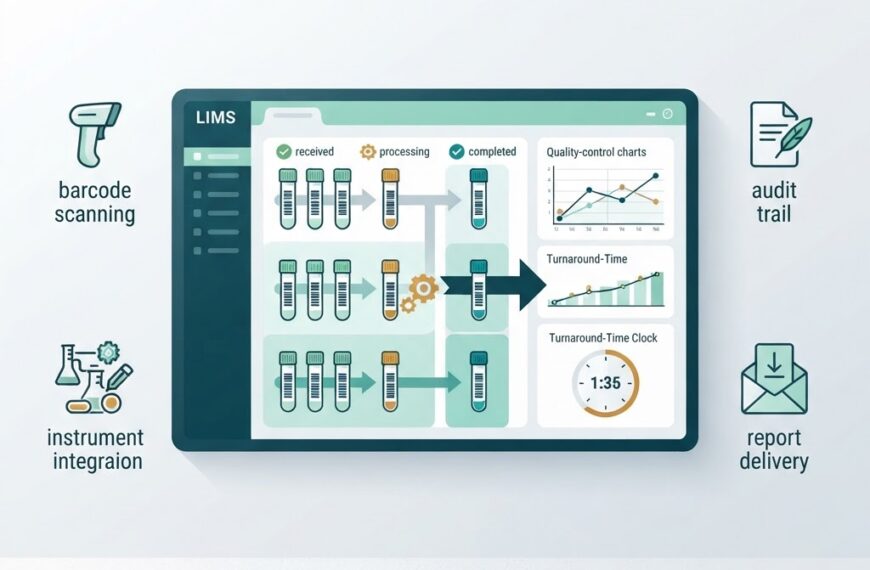
The most immediate difference after deploying a LIMS is that every sample entering the lab gets a unique identifier — usually a barcode — that follows it through every step. No more writing patient details on tube labels by hand or searching through logbooks to find where a sample is in its journey.
A laboratory information management system creates a single digital trail for each specimen. When a phlebotomist collects a sample, the system records who collected it, when, and from whom. When the sample reaches the lab, a scan confirms receipt. When it moves to analyzers, to review, and finally to reporting, each step is logged with a timestamp and the name of the person responsible.
This is not a marginal improvement. Labs that previously relied on manual logs often discover, during their first week with a LIMS, that a significant number of samples had been sitting at unrecorded stages for longer than anyone realised.
Fewer Errors, Fewer Reruns
Manual transcription is one of the largest sources of error in a pathology lab. A technician reads a result from an analyzer screen and types it into a report. A receptionist writes a patient name on a form and someone else reads it differently downstream. Each handoff is an opportunity for a mistake.
A LIMS eliminates most of these transcription steps by connecting directly to analyzers and instruments through standard interfaces (such as HL7 or ASTM protocols). Results flow automatically from the instrument into the patient’s record, matched by barcode. The report assembles itself without anyone rekeying a single number.
The practical benefits of LIMS that labs observe in this area include:
- Fewer transcription errors: Results enter the system once, at the source.
- Fewer reruns: When results are matched correctly the first time, the lab does not waste reagents and time redoing tests because of doubts about which sample belonged to which patient.
- Fewer misidentified samples: Barcode-based tracking means a sample is tied to a patient record from collection to disposal, not to a handwritten label that can peel off or be misread.
- Faster error detection: When something goes wrong — a result outside expected range, a delayed sample — the system flags it immediately rather than discovering it during an audit.
Turnaround Time: The Metric That Matters Most
For a diagnostic lab, turnaround time (TAT) — the time between sample collection and report delivery — is the single most important operational metric. Referring doctors and patients judge the lab’s reliability by how quickly results come back.
A LIMS improves TAT in several ways simultaneously:
| Bottleneck Without LIMS | How a LIMS Resolves It |
|---|---|
| Samples wait at reception for manual data entry | Barcode scan at receipt takes seconds |
| Technicians batch results for manual report writing | Results auto-populate reports as soon as the analyzer finishes |
| Reports sit in a queue for a consultant’s physical signature | Digital auto-approval rules route normal results directly; abnormal ones are flagged for review |
| Reports printed and couriered or faxed to doctors | Reports delivered instantly via email, SMS, or patient portal |
| No visibility into where a sample is stuck | Real-time dashboard shows every sample’s current stage |
The cumulative effect is substantial. Labs that measure TAT before and after LIMS implementation typically see a meaningful reduction, especially in the gaps between process steps — the “waiting around” time that manual systems create.
Quality Control Becomes Systematized
Quality control (QC) in a pathology lab is not optional. Accreditation bodies such as NABL in India, which aligns with international standards like ISO 15189, require labs to demonstrate that quality control processes are followed consistently, not just when things go wrong.
Without a LIMS, QC is often paper-driven. Daily QC runs are logged in register books. When a QC value falls outside the acceptable range, it may or may not be documented properly. Reviewing QC history means flipping through months of physical records.
A LIMS changes this by:
- Tracking QC runs automatically: When an analyzer performs a daily QC, the LIMS records the result, compares it against the expected range, and flags deviations.
- Enforcing rules before patient results are released: The system can be configured so that if a QC run has not been completed or has failed, patient results from that analyzer cannot be approved for reporting until the issue is resolved.
- Maintaining a searchable, exportable QC history: During audits, the lab can pull QC records for any instrument, any test, any date range, in seconds instead of days.
- Supporting accreditation documentation: The traceability and audit trail that a LIMS provides maps directly onto the requirements of standards like ISO 15189 and ISO/IEC 17025.
Better Inventory and Reagent Management
Pathology labs deal with reagents, consumables, and kits that have expiry dates, lot numbers, and storage requirements. Managing this manually is error-prone and can lead to two costly problems: running out of a critical reagent mid-test, or using expired reagents that compromise result validity.
A LIMS tracks inventory at the lot level. When a reagent is used for a test, the system knows which lot it came from. If a manufacturer issues a recall or a lot is found to be defective, the lab can identify every patient sample that was tested using that lot — something that is practically impossible with manual records.
Day-to-day, this means:
- Low-stock alerts before reagents run out, so procurement can happen proactively.
- Expiry tracking that prevents the use of outdated materials.
- Lot-level traceability that links every result to the specific reagent lot used.
- Consumption analytics that help the lab forecast demand and control costs.
Data That Supports Decisions, Not Just Reports
A pathology lab without a LIMS generates a lot of data, but it is scattered across logbooks, spreadsheets, and individual workstations. Asking a simple question — “How many CBC tests did we do last month, and what was our average TAT?” — can mean hours of manual compilation.
With a LIMS, operational data lives in a structured database. Lab managers can generate reports on:
- Test volumes by type, by day, by department, by referring doctor.
- Turnaround time broken down by test, by shift, by analyser.
- Error and rerun rates tracked over time.
- Revenue and billing summaries that include pending payments and discounts.
This is not about vanity metrics. It is about giving the lab leadership the information needed to make operational decisions: which tests to add, which shifts are understaffed, which analysers are underutilised, and where the bottlenecks actually are.
Integration With the Broader Healthcare Ecosystem
A modern pathology lab does not operate in isolation. It receives test requests from hospital information systems (HIS), electronic medical records (EMR), and online booking platforms. It delivers results to referring physicians, patient portals, and sometimes directly to insurance providers for claims processing.
A LIMS serves as the integration hub for all of these. Through standard healthcare interoperability protocols — primarily HL7 — a LIMS can:
- Receive test orders electronically from a hospital or clinic, eliminating the need for paper requisitions.
- Send results back to the ordering physician’s system automatically.
- Support home sample collection workflows, where a phlebotomist in the field receives assignments, navigates to the patient, collects the sample, and updates the system in real time from a mobile device.
For labs that serve multiple collection centres, branches, or hospital partners, this integration is not a luxury. It is the only practical way to maintain a single source of truth across a distributed operation.
Ideativemind’s own IdLabNet platform is built around this principle — a LIMS designed for multi-branch diagnostic operations with integrated sample tracking, reporting, and home collection management in one system.
Patient Experience: The Indirect Benefit
The benefits of LIMS software are often discussed in terms of lab operations, but they extend to the patient experience as well. When a lab runs efficiently:
- Reports reach patients faster, through SMS alerts, email, or a patient portal — no more phone calls to ask if results are ready.
- Errors are less frequent, which means fewer instances of a patient being told their sample needs to be recollected.
- Home collection is coordinated more reliably, with phlebotomists showing up at the scheduled time and the system tracking the sample from the patient’s doorstep.
- Bills are accurate, with charges calculated by the system rather than estimated by hand.
For a lab competing on service quality — not just price — these patient-facing improvements matter as much as the internal operational gains.
Compliance and Audit Readiness
Accreditation audits are stressful under any system, but they are dramatically less stressful with a LIMS. The reason is simple: everything an auditor wants to see — who did what, when, with which equipment, using which reagent lot, under which QC conditions — is already recorded and timestamped in the system.
During an audit, lab staff can demonstrate:
- Personnel competency records — who is qualified to perform which tests.
- Instrument calibration and maintenance logs — when equipment was last serviced and calibrated.
- QC records — daily, weekly, and monthly quality control data with deviation tracking.
- Sample traceability — the complete journey of any patient sample from collection to disposal.
- Report delivery confirmation — proof that a result was delivered to the ordering physician and patient.
This level of documentation, maintained continuously rather than assembled in a panic before an audit, is one of the most cited benefits of LIMS adoption among labs pursuing or maintaining NABL or ISO 15189 accreditation.
What Does Not Change
It is worth being clear about what a LIMS does not do. A LIMS does not:
- Replace the expertise of pathologists and technicians. It removes administrative friction so they can focus on the scientific work.
- Fix bad processes on its own. If a lab’s workflow is inefficient before the LIMS, the LIMS will digitise that inefficiency unless processes are redesigned as part of implementation.
- Guarantee accreditation. It supports the documentation and traceability that accreditation requires, but the lab still needs to follow the standards in practice.
A successful LIMS implementation is as much about process change as it is about software. For a structured approach, see our guide on core LIMS features and the principles that guide how the system should be configured for your lab.
The Bottom Line
The benefits of LIMS software for pathology labs are not abstract efficiencies on a slide. They are concrete, observable changes: fewer errors, faster turnaround, systematized quality control, better inventory management, data-driven decisions, seamless integration with hospital systems, improved patient experience, and audit-ready compliance.
For a lab that is growing — adding tests, adding branches, or serving more referring doctors — the question is not whether to adopt a LIMS, but how to choose and implement one well. If you would like to explore a LIMS designed for Indian diagnostic operations, visit IdLabNet or get in touch with Ideativemind.

 By
By