
If you have asked a chatbot a question and gotten a useful answer, you have interacted with a language model. But that chatbot did not book your flight, send a confirmation email, and update your calendar. An AI agent could.
The difference matters. As businesses move from experimenting with AI to deploying it in real workflows, the spotlight is shifting from models that talk to systems that act. This guide explains what an AI agent is, how it works, the main types, and how it differs from the chatbots and large language models most people are already familiar with.
What Is an AI Agent?
An AI agent is a software system that perceives its environment, reasons about goals, and takes actions autonomously to achieve those goals. The definition comes from the foundational artificial intelligence textbook by Stuart Russell and Peter Norvig, which describes an intelligent agent as any entity that perceives its environment through sensors and acts upon it through actuators.
In practical terms, an AI agent combines several capabilities:
- Perception: it takes in input, whether that is text, a database query, a web page, or sensor data.
- Reasoning: it processes that input to understand what is being asked or what state the world is in.
- Planning: it breaks a goal into steps and decides what to do first, second, and third.
- Action: it executes, by calling external tools, APIs, databases, or other software.
- Memory: it remembers what it has already done and what happened as a result, so it can adjust.
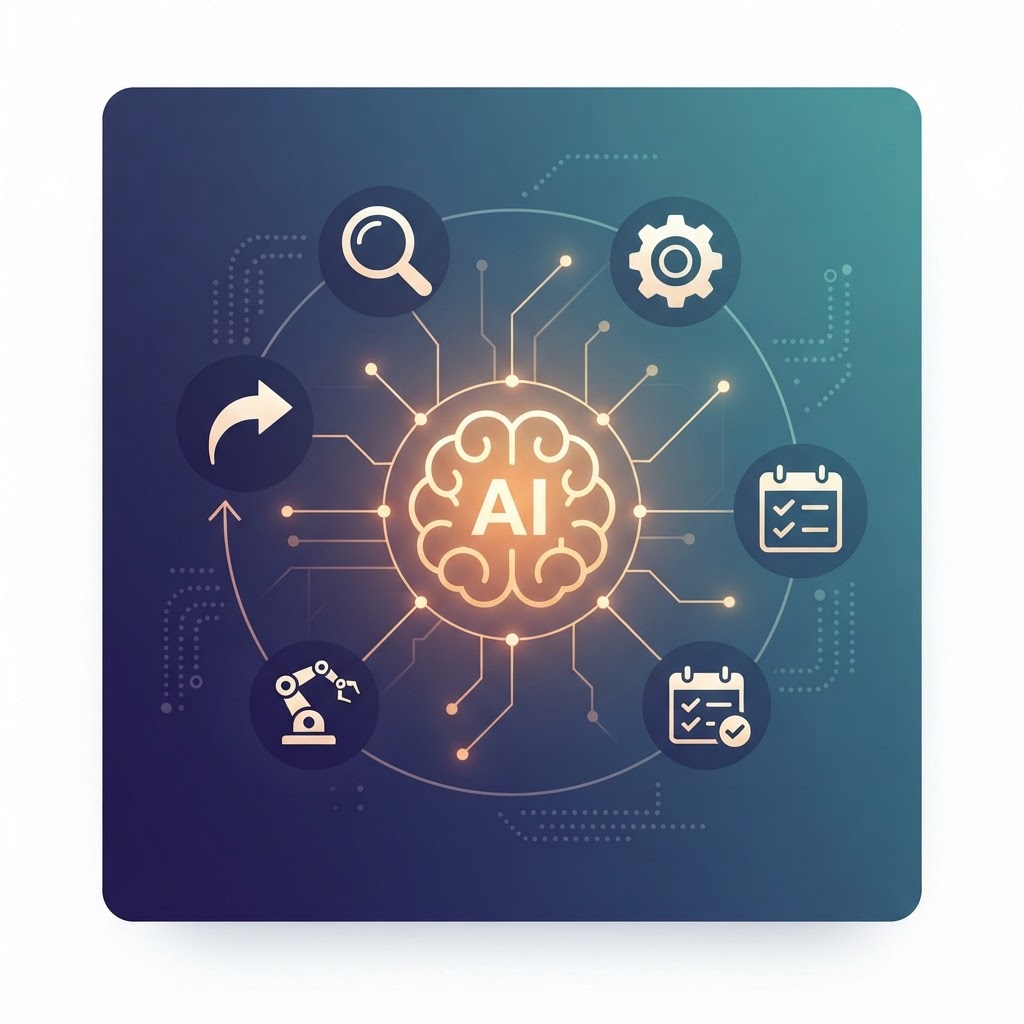
A useful mental model: a language model is the brain; the agent is the brain plus the hands, eyes, and memory needed to actually get something done.
How AI Agents Work
A modern AI agent is typically built around a large language model (LLM) as its reasoning engine. The LLM decides what to do next, but the agent system wraps it with additional components that let it interact with the outside world.
Here is a simplified version of the cycle an agent runs through:
| Step | What Happens | Example |
|---|---|---|
| 1. Receive goal | User or system provides a task | “Summarize the latest lab reports and email the anomalies to the pathologist” |
| 2. Perceive | Agent gathers relevant input | Fetches reports from the LIMS database |
| 3. Reason | LLM analyzes what it has | Identifies which results fall outside reference ranges |
| 4. Plan | Agent breaks the task into steps | 1) Query database 2) Analyze results 3) Draft email 4) Send |
| 5. Act | Agent calls tools to execute | Sends the email via an API |
| 6. Observe | Agent checks the result | Confirms email was sent, logs the action |
| 7. Repeat or finish | If the goal is not met, loop back | If no anomalies were found, skips the email and reports all-clear instead |
This observe-reason-act loop is at the heart of how agents work. A key research contribution here is the ReAct framework (Reasoning and Acting), introduced by Yao et al. in 2022. ReAct showed that language models perform better when they interleave reasoning steps with actions, rather than thinking everything through first and acting afterwards. The paper is published and available at arXiv (arxiv.org/abs/2210.03629).
The Five Types of AI Agents
Russell and Norvig classify intelligent agents into five types, from simplest to most sophisticated. This taxonomy predates modern LLMs but still maps cleanly to how today’s agents are built.
1. Simple Reflex Agents
These agents act based only on the current situation, using predefined rules. They do not consider history or future consequences. A thermostat that turns on the heater when the temperature drops below a set point is a simple reflex agent. Fast, but unable to handle situations the rules did not anticipate.
2. Model-Based Reflex Agents
These agents maintain an internal model of the world, letting them reason about things they cannot directly observe. For example, a self-driving car that tracks the likely position of a vehicle that was visible a moment ago but is now hidden behind a truck is using a model-based approach.
3. Goal-Based Agents
These agents work toward explicit goals rather than just reacting to conditions. They can plan ahead: if the goal is “reach the destination,” the agent evaluates different routes and picks the one most likely to succeed. Most business workflow agents fall into this category.
4. Utility-Based Agents
These agents optimize for the best outcome among competing options, using a utility function to measure how desirable each outcome is. A delivery-routing agent that balances speed, fuel cost, and traffic conditions is utility-based. It does not just want to reach the destination; it wants to reach it in the best way.
5. Learning Agents
These agents improve over time. A learning agent has a critic that evaluates its performance and feeds that feedback back so the agent gets better with experience. Recommendation engines that adapt based on what you click are learning agents. This is where AI agents gain their power: they are not static programs but systems that evolve.
AI Agent vs Chatbot vs LLM: What’s the Difference?
These three terms get used interchangeably, but they describe different things.
A large language model (LLM) is a model trained to predict and generate text. On its own, it has no memory between conversations, no ability to call external tools, and no sense of goals beyond completing the current text sequence.
A chatbot is an application interface built on top of a language model (or an older rules-based system). It takes in text and gives back text. Most chatbots you interact with today are LLMs with a chat interface. They respond but do not act.
An AI agent uses a language model as its reasoning engine and adds the ability to plan, use tools, maintain memory, and execute multi-step actions autonomously. A chatbot tells you how to book a flight. An agent books it.
| Capability | LLM (standalone) | Chatbot | AI Agent |
|---|---|---|---|
| Understands text | Yes | Yes | Yes |
| Maintains memory | No | Session only | Yes, short and long-term |
| Uses external tools | No | Limited | Yes |
| Plans multi-step tasks | No | Minimal | Yes |
| Takes autonomous action | No | No | Yes |
| Improves from feedback | No | No | Can be designed to (learning agents) |
IBM describes the distinction this way: AI agents are often referred to as LLM agents because they use language models as their core reasoning component, but the agent system adds the planning, tool use, and memory that make autonomous action possible.
Real-World Use Cases for AI Agents
AI agents are already at work across industries. Here are verified categories where agents are deployed:
Software Development
Coding agents can read a codebase, write new functions, run tests, and fix errors based on test output. They follow the same reason-act-observe loop: understand the task, write code, run it, check the result, fix if needed.
Customer Support
Unlike a chatbot that only answers questions, a support agent can look up an order in the database, process a refund via a payment API, and send a confirmation email, all without human intervention. This goes beyond the use cases discussed in our AI in customer service article.
Data Analysis and Reporting
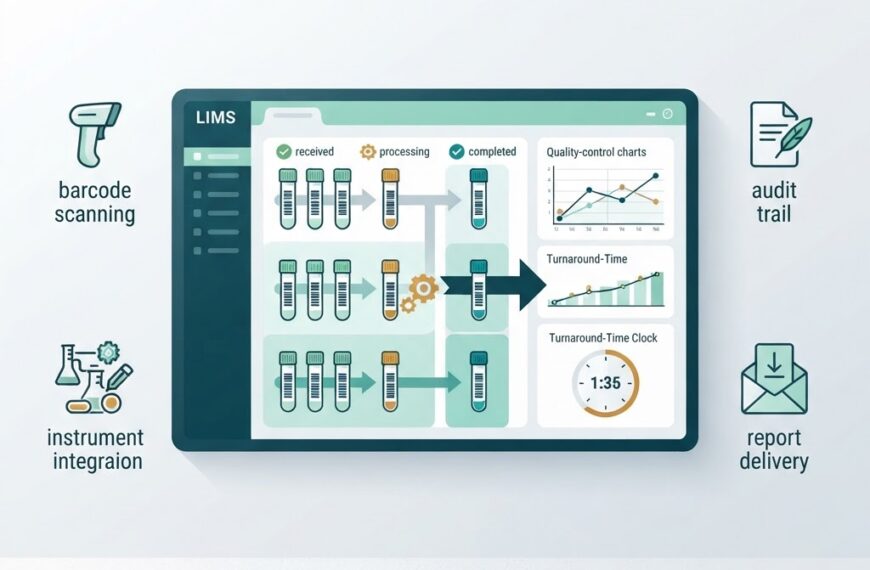
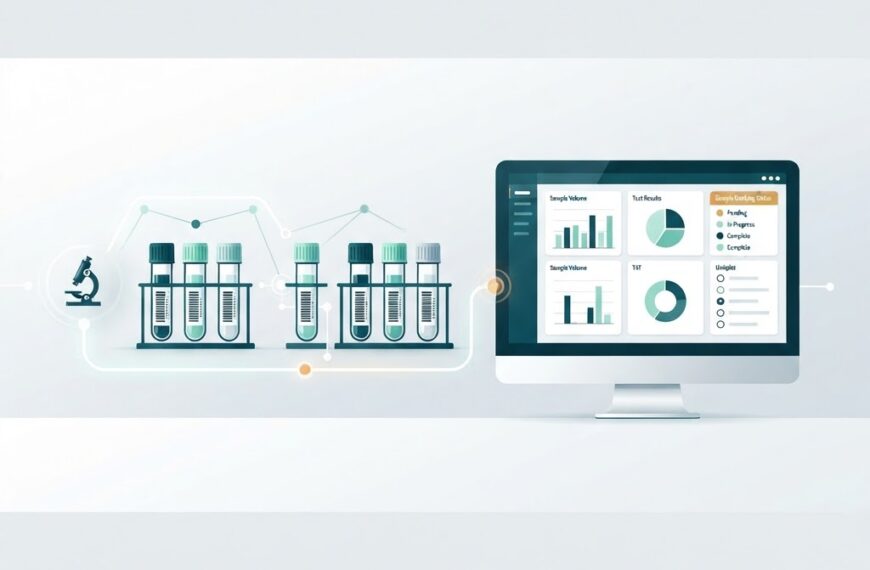
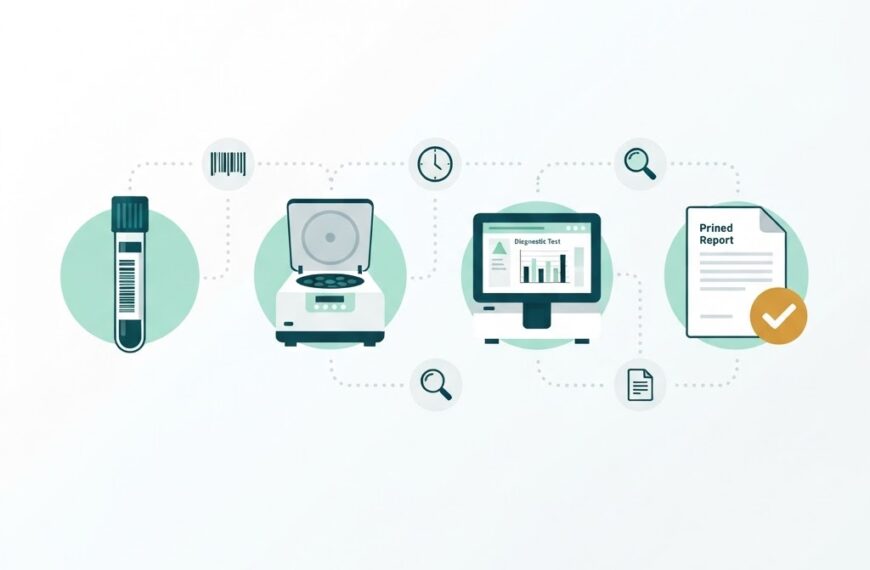
An agent can pull data from multiple sources, run analysis, generate charts, and compile a report. In laboratory settings, this is where LIMS integration becomes powerful. A system like IdLabNet can feed test data to an agent that flags anomalies, prepares summaries, and routes them to the right person.
Workflow Automation
Agents can coordinate multi-step business processes: lead qualification, invoice processing, document review. The key advantage is that an agent can handle exceptions and make decisions within the workflow, not just follow a rigid script.
What Makes a Good AI Agent?
Not every system that calls itself an agent lives up to the name. A genuinely useful AI agent typically has these characteristics:
- Clear goal definition: the agent knows what success looks like before it starts.
- Reliable tool integration: the agent’s tools (APIs, databases, search) actually work and return structured data.
- Error handling: when a step fails, the agent can recover, retry, or ask for help instead of crashing.
- Observability: humans can see what the agent did and why, which is critical for trust and debugging.
- Scope limits: the agent operates within defined boundaries and does not take actions it was not designed for.
Multi-Agent Systems
A single agent can only do so much. In complex scenarios, multiple agents can work together, each specializing in a different task. One agent might research, another drafts, a third reviews. This is called a multi-agent system, and it mirrors how human teams divide labor.
Multi-agent systems are an active area of research because they introduce new challenges: how agents coordinate, how they share information, and how conflicts are resolved when agents disagree.
Limitations and Considerations
AI agents are powerful but not magical. Important limitations include:
- Hallucination: because the reasoning engine is a language model, it can produce confident but wrong outputs. Agents that act on bad reasoning can make real-world mistakes.
- Cost: running an agent through many reasoning-acting cycles consumes significant compute, especially for complex tasks.
- Reliability: agents that work in demos can fail in production due to edge cases, API changes, or unexpected inputs.
- Security and control: an agent that can take actions needs guardrails. Unrestricted agent autonomy is a risk, which is why production agents almost always include human-in-the-loop checkpoints for consequential actions.
The Bottom Line
An AI agent is a system that does not just answer questions but takes action. It perceives, reasons, plans, and executes, using a language model as its core and wrapping it with tools, memory, and planning. Whether you are automating a lab workflow, building a support system, or streamlining internal processes, understanding how agents work is the first step to using them well.
If you are exploring how AI and automation can fit into your business, get in touch with Ideativemind or explore our cloud solutions for scalable, AI-ready infrastructure.

 By
By