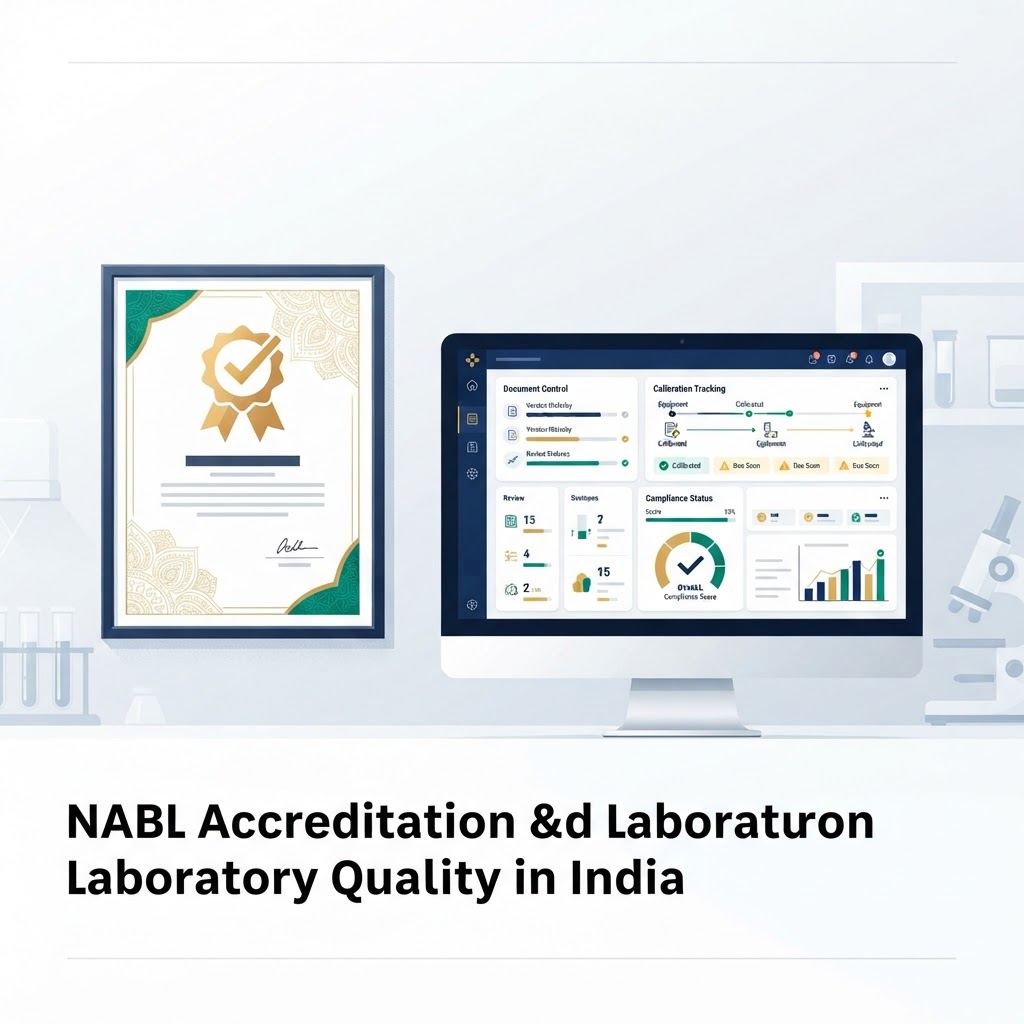

What Is NABL Accreditation?
The National Accreditation Board for Testing and Calibration Laboratories (NABL) is India’s official accreditation body for laboratories. A constituent board of the Quality Council of India (QCI), NABL provides voluntary, third-party accreditation that formally recognizes a laboratory’s technical competence and quality management system.
For medical and diagnostic laboratories, NABL accreditation is granted against ISO 15189, the international standard for medical laboratories. The current version is ISO 15189:2022, the fourth edition, which replaced the 2012 version. NABL’s accreditation system itself is established in accordance with ISO/IEC 17011, the standard for bodies that accredit conformity assessment organizations.
NABL is a signatory to Mutual Recognition Arrangements (MRAs) with both ILAC (International Laboratory Accreditation Cooperation) and APAC (Asia Pacific Accreditation Cooperation). This means test results from a NABL-accredited laboratory are accepted across MRA partner countries, reducing technical barriers to trade and building international trust in a lab’s reports.
What Does NABL Accredit?
NABL grants accreditation across several categories, each governed by a specific international standard:
| Category | Standard |
|---|---|
| Testing Laboratories | ISO/IEC 17025 |
| Calibration Laboratories | ISO/IEC 17025 |
| Medical Testing Laboratories | ISO 15189 |
| Proficiency Testing Providers (PTP) | ISO/IEC 17043 |
| Reference Material Producers (RMP) | ISO 17034 |
| Biobanks | ISO 20387 |
For diagnostic and pathology labs in India, the relevant accreditation is under ISO 15189 for medical testing laboratories. This is what most labs pursue when they say they want “NABL accreditation.”
The NABL Accreditation Process
Getting accredited is a structured, multi-stage process. Here are the key steps a medical laboratory goes through:
1. Application
The laboratory submits an application to NABL along with the required documents, including the quality manual and standard operating procedures (SOPs). NABL provides specific application forms for medical labs under its documented procedures.
2. Document Review
NABL reviews the submitted quality manual and supporting documents to verify they meet the requirements of ISO 15189. Key reference documents include NABL 112B (Guidance for Medical Laboratories) and NABL 100A (General Information Brochure). If gaps are found, the lab is asked to address them before moving forward.
3. Pre-Assessment (Optional)
Labs may opt for a pre-assessment, a preliminary on-site evaluation that helps identify nonconformities before the formal initial assessment. This is not mandatory but is recommended for labs going through accreditation for the first time.
4. Initial Assessment
A team of NABL assessors conducts an on-site assessment of the laboratory. They examine every aspect of operations: personnel qualifications, equipment calibration and maintenance, testing procedures, quality control practices, document control, record keeping, and the overall management system. Any nonconformities are documented, and the lab is given time to take corrective action.
5. Accreditation Decision
After corrective actions are verified, NABL makes the accreditation decision. If approved, the laboratory receives its accreditation certificate, valid for a four-year accreditation cycle. During this cycle, the lab undergoes surveillance assessments to ensure continued compliance.
Why NABL Accreditation Matters for Diagnostic Labs
NABL accreditation is not just a certificate on the wall. It has tangible benefits for laboratories, their patients, and the healthcare system.
Patient Trust and Clinical Confidence
Accreditation gives patients and referring doctors confidence that test results are accurate, reproducible, and produced by a competent laboratory following internationally accepted procedures. In healthcare, where diagnostic decisions directly affect patient outcomes, this trust is critical.
Regulatory and Empanelment Advantages
NABL accreditation is increasingly tied to regulatory benefits in India. For example, under the Central Government Health Scheme (CGHS), NABL-accredited medical laboratories receive 15% higher reimbursement rates than non-accredited labs. Many insurance providers, corporate health programs, and government empanelment schemes also prefer or require NABL accreditation.
International Recognition
Through ILAC and APAC MRA arrangements, test reports from NABL-accredited labs are accepted in dozens of countries. This matters for labs that serve international patients, support cross-border clinical trials, or work with global healthcare partners.
Operational Discipline
The process of preparing for and maintaining accreditation forces a laboratory to systematize its operations. Documented procedures, regular internal audits, controlled equipment calibration, and structured nonconformity management all become part of daily practice, not just assessment-week activities.
What ISO 15189:2022 Requires
Understanding the standard helps explain why lab software plays such a central role in maintaining compliance. ISO 15189:2022 is organized around both management and technical requirements. Here are the core areas a lab must satisfy:
- Document and record control (clauses 8.3-8.4): All procedures, manuals, and records must be version-controlled, reviewed, and retrievable. Obsolete documents must be removed from use.
- Personnel competence (clause 6.2): Every role must have defined competence requirements, and staff must be assessed on an ongoing basis with documented evidence.
- Equipment qualification and calibration (clause 6.4): All equipment must be qualified, calibrated with traceability to reference standards, and maintained on a defined schedule.
- Examination process control (clause 7.3): Internal quality control (IQC) and external quality assessment (EQA) must be performed with statistical rules applied and corrective actions for failures.
- Data and information management (clause 7.6): Laboratory information systems must ensure data integrity, security, and traceability of results throughout the examination process.
- Risk and opportunity management (clause 8.5): The 2022 revision introduced a stronger risk-based approach, requiring labs to identify risks and opportunities and act on them.
- Nonconformity management (clauses 7.5, 8.7): Nonconformities must be logged, investigated with root cause analysis where warranted, and corrective actions must be tracked to closure with effectiveness verified.
- Internal audit and management review (clauses 8.8-8.9): Regular internal audits and management reviews must close the quality loop with documented inputs, outputs, and actions.
How Lab Software Helps with NABL Compliance
This is where a Laboratory Information Management System (LIMS) becomes not just an operational tool but a compliance asset. The same system that manages samples, tests, and reports can directly support the ISO 15189 requirements that NABL assessors evaluate.
Document Control Made Automatic
A modern LIMS maintains version-controlled SOPs, policies, and forms within the system. When a document is revised, the previous version is automatically archived and marked obsolete. Review cycles can be scheduled with reminders, and access rights ensure only authorized personnel can approve or edit controlled documents. This directly satisfies clauses 8.3 and 8.4 without the manual overhead of paper binders and sign-off sheets.
Complete Sample Traceability
From collection to reporting, a LIMS tracks every sample with a unique identifier. Every step in the process, who performed it, when, and with which equipment is recorded in an immutable audit trail. This traceability is exactly what assessors look for when evaluating data integrity under clause 7.6.
Equipment Calibration and Maintenance Tracking
LIMS systems maintain equipment records with calibration schedules, certificate references, and maintenance history. Automated alerts notify staff when calibration is due or when an instrument is approaching its qualification expiry. This ensures clause 6.4 compliance without relying on spreadsheets or memory.
Quality Control and EQA Integration
Many LIMS platforms support IQC data entry with built-in statistical rules (such as Westgard rules) and flag out-of-control results automatically. EQA participation and performance can be tracked with corrective actions linked to any failures. This closes the loop on clause 7.3 requirements.
Personnel Competence Records
A LIMS can store competency records for each staff member: qualifications, training history, assessment results, and authorization levels. When an assessor asks who is authorized to perform a specific test, the answer is one query away, supporting clause 6.2.
Nonconformity and CAPA Management
Nonconformities can be logged directly in the system with root cause analysis, corrective actions, assigned owners, and effectiveness verification dates. Trending across categories and time periods gives the quality manager a real-time view of recurring issues, which is exactly what an assessor expects to see under clauses 7.5 and 8.7.
Audit-Ready at All Times
When every record, calibration log, QC result, and corrective action lives in a single system with a full audit trail, the lab is audit-ready every day. There is no need to spend weeks assembling evidence before a surveillance assessment. The management review (clause 8.9) can pull real data from the system rather than manually aggregating reports.
NABL Compliance Without Software: The Spreadsheet Problem
Many labs attempt to manage NABL compliance with spreadsheets, shared drives, and paper records. This approach creates predictable problems:
- Version chaos: Multiple copies of SOPs circulate, and nobody is sure which is the current version.
- Calibration blind spots: Instruments miss their calibration dates because tracking is manual and scattered.
- No real-time trending: Nonconformities are logged but never analyzed for patterns.
- Audit scramble: Every assessment becomes a weeks-long document hunt.
- Data integrity gaps: Spreadsheets can be edited without a trace, which fails the audit trail requirements of ISO 15189.
A LIMS eliminates these issues by making compliance a byproduct of daily operations rather than a separate, parallel effort.
Choosing Lab Software for NABL Compliance
If you are selecting a LIMS to support your NABL accreditation journey, look for these capabilities:
| Requirement Area | What to Look For in Software |
|---|---|
| Document Control (8.3-8.4) | Version control, approval workflows, access restrictions, automatic archiving |
| Equipment (6.4) | Calibration scheduling, certificate storage, maintenance logs, alert notifications |
| QC and EQA (7.3) | IQC entry with statistical rules, EQA tracking, corrective action workflow |
| Data Integrity (7.6) | Immutable audit trail, electronic signatures, access logging |
| Personnel (6.2) | Competency records, training tracking, authorization management |
| Nonconformity (7.5, 8.7) | CAPA management, root cause documentation, effectiveness tracking, trending dashboards |
| Internal Audit (8.8) | Audit scheduling, findings tracking, closure verification |
Conclusion
NABL accreditation is the gold standard for laboratory quality in India. It signals to patients, doctors, regulators, and international partners that a lab produces reliable results through a systemized, audited process. The requirements of ISO 15189:2022 are comprehensive, but they are not mysterious. They call for controlled documents, traceable processes, calibrated equipment, competent personnel, and continuous improvement, all backed by evidence.
Laboratory software does not earn accreditation for a lab, but it makes earning and maintaining it far more manageable. A well-chosen LIMS turns the daily work of running a lab into the evidence base that an assessor needs to see. For labs pursuing NABL accreditation or preparing for their next surveillance assessment, investing in the right software is not an optional convenience. It is a strategic decision that pays off at every assessment, every audit, and every patient interaction.
If your lab is planning for NABL accreditation and wants a system that supports the full ISO 15189 requirements, IdLabNet by Ideativemind is built for diagnostic laboratories. Get in touch to see how it works for your lab.


 By
By