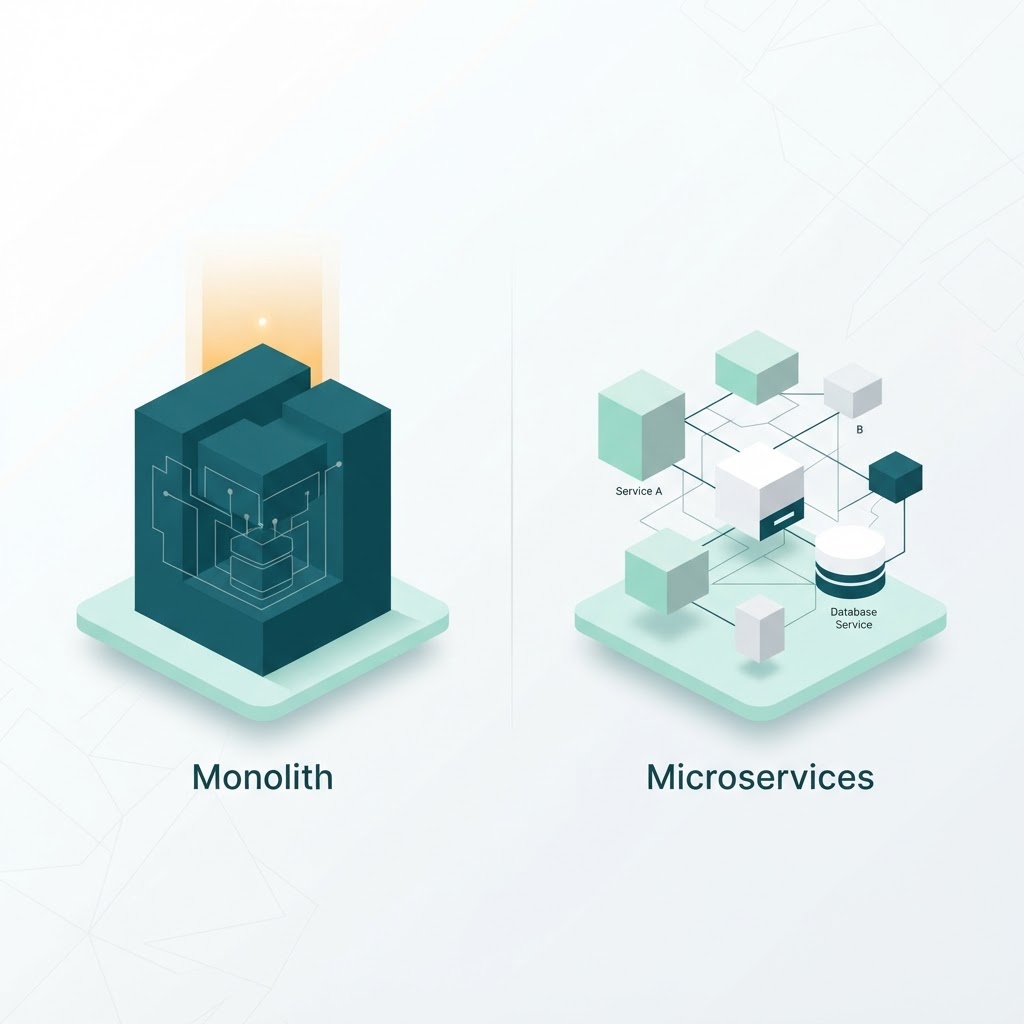

When a team sets out to build a new application, one of the earliest and most consequential decisions is how to structure the codebase. The two dominant approaches are a monolithic architecture and a microservices architecture. Each has well-documented strengths and trade-offs, and the right choice depends on your team size, domain complexity, scaling needs, and operational maturity.
This article breaks down what each architecture means, how they differ, and when to choose one over the other.
What Is a Monolithic Architecture?
A monolithic architecture is the traditional model of software development in which a single codebase handles all of an application’s business functions. The user interface, business logic, data access layer, and any background processing all live together in one deployable unit. Everything communicates through direct function calls within the same process.
According to IBM, a monolithic application typically contains three core components: a client-side user interface, a server-side application that manages business logic, and a database (usually a relational database management system). All three are bundled into a single codebase and deployed as one unit.
This approach dominated software development for decades. It is simple to understand, straightforward to test end-to-end, and easy to deploy because you ship a single artifact. For small teams and early-stage products, those qualities matter a great deal.
Advantages of a Monolith
- Simpler development: One codebase, one language, and one set of dependencies make onboarding fast and debugging from a central logging system straightforward.
- Easier deployment: A single executable or directory is all you need to ship. There are no service-to-service networks to configure.
- Lower operational overhead: No API gateways, service meshes, or distributed tracing tools are required to keep the system running.
- Tight code cohesion: Function calls within a process are faster than network calls between services, which means lower latency for inter-component communication.
Drawbacks of a Monolith
- Harder to scale selectively: If only one part of the application sees heavy traffic, you scale the entire application because it is a single deployable unit.
- Resistance to new technologies: Introducing a new language or framework usually means retooling the whole application.
- Growing complexity over time: As the codebase grows, it becomes harder to navigate, and changes in one module can have unintended side effects elsewhere.
- Single point of failure: If one component crashes, it can bring down the entire application.
What Is a Microservices Architecture?
A microservices architecture is an approach in which an application is built as a suite of small, independently deployable services. Each service runs in its own process, owns its own data, and communicates with other services through lightweight mechanisms, typically HTTP-based APIs or asynchronous messaging.
Martin Fowler, one of the most widely cited writers on the topic, describes the microservice architectural style as “an approach to developing a single application as a suite of small services, each running in its own process and communicating through lightweight mechanisms.”
Each microservice is built around a specific business capability. An e-commerce application might have separate services for catalog, cart, orders, payments, and inventory. Each service can use a different technology stack, be deployed independently, and be scaled up or down based on its own demand.
Advantages of Microservices
- Independent scaling: You can scale only the services that need it, instead of scaling the entire application. If the payment service sees a spike, you add more instances of just that service.
- Technology flexibility: Each team can choose the language, framework, and database best suited to its service.
- Independent deployment: Services can be updated and deployed without taking down the rest of the application. This supports continuous delivery pipelines.
- Fault isolation: If one service fails, the rest of the system can often continue operating, especially if designed with graceful degradation in mind.
Drawbacks of Microservices
- Operational complexity: Managing dozens of services requires containerization, orchestration (typically Kubernetes), service discovery, distributed tracing, and monitoring across services.
- Harder debugging: A single user request may pass through multiple services. Tracing the root cause of a problem requires distributed logging and tracing tools.
- Increased latency: Network calls between services are slower than in-process function calls. Each hop adds overhead.
- Data consistency challenges: With each service owning its own database, maintaining consistency across services requires patterns like the saga pattern or eventual consistency, which add complexity.
- Higher team skill requirements: Building and operating microservices well demands mature DevOps practices, CI/CD pipelines, and experience with distributed systems.
Monolith vs Microservices: A Side-by-Side Comparison
| Factor | Monolith | Microservices |
|---|---|---|
| Codebase | Single, unified codebase | Multiple, independent codebases |
| Deployment | One deployable unit | Each service deployed independently |
| Scaling | Scale the entire application | Scale individual services |
| Technology stack | Typically one language/framework | Each service can use a different stack |
| Communication | In-process function calls | Network calls (HTTP, gRPC, messaging) |
| Database | Usually a single shared database | Each service owns its own data store |
| Testing | End-to-end testing from one place | Requires testing each service plus integration tests |
| Debugging | Centralized, straightforward | Distributed, requires tracing tools |
| Team structure | Works well with small teams | Enables multiple teams to work in parallel |
| Operational overhead | Low | High (orchestration, monitoring, networking) |
| Time to market (initial) | Faster | Slower due to upfront design |
When to Choose a Monolith
A monolithic architecture is the right starting point in several common scenarios:
- You are building an MVP or proof of concept. Speed matters more than scale at this stage. A monolith lets you iterate quickly without worrying about distributed system infrastructure.
- Your team is small. If you have fewer than five to eight developers, the operational overhead of microservices will likely outweigh the benefits.
- Your application domain is relatively simple. If the business logic fits comfortably within one codebase without becoming tangled, a monolith is a natural fit.
- You want to keep operational costs low. A monolith can run on a single server or a small cluster with conventional monitoring and deployment tooling.
Many successful companies started with a monolith, including well-known examples like Basecamp, GitHub in its early years, and Stack Overflow. The key insight is that starting with a monolith is not a mistake. It is a pragmatic engineering decision.
When to Choose Microservices
Microservices become a better fit when:
- Your application is large and complex. When a single codebase grows beyond what a team can reason about effectively, splitting it into services bounded by business capability helps manage complexity.
- You need independent scaling. If different parts of your application have very different traffic or compute profiles, microservices let you scale them separately.
- Multiple teams are working on the same product. Microservices allow teams to own, build, and deploy their services independently without stepping on each other.
- You need technology diversity. If one part of your system is better suited to a different language or database, microservices make that possible.
Microservices are not a prerequisite for scale. Companies like Stack Overflow have demonstrated that a well-architected monolith can handle enormous traffic. The decision should be driven by your specific needs, not by what large tech companies happen to be doing.
The Modular Monolith: A Practical Middle Ground
There is a third option that does not get as much attention: the modular monolith. In this approach, the application remains a single deployable unit, but the codebase is organized into well-bounded modules with clear interfaces. Each module owns its own data and exposes only a defined API to other modules.
The modular monolith gives you many of the benefits of microservices (clear boundaries, independent modules, easier to reason about) without the operational complexity of distributed systems. If the time comes to extract a module into a separate service, the bounded module makes that transition far easier than it would be with an unstructured monolith.
This approach is increasingly recommended by experienced architects as the default starting point for teams that are unsure whether they need microservices.
How to Decide: A Practical Checklist
Before choosing an architecture, ask yourself these questions:
- How large is the development team? Small teams should default to a monolith or modular monolith.
- What is the expected scale of the application? If you are not expecting millions of users or highly uneven traffic patterns, a monolith will likely suffice.
- How mature is the DevOps setup? Microservices require CI/CD, containerization, and monitoring. If these are not in place, a monolith is the safer choice.
- How complex is the business domain? A complex domain with distinct sub-domains may benefit from being split into services, but a modular monolith can capture those boundaries first.
- How quickly do you need to ship? A monolith gets you to market faster. Microservices require upfront investment in infrastructure.
Summary
There is no universal winner in the monolith vs microservices debate. The best architecture is the one that fits your team, your product, and your operational maturity today, while leaving room to evolve.
For most teams starting out, a monolith or modular monolith is the right choice. It is simpler, faster, and cheaper to build and operate. As the application grows and the team scales, extracting services from a well-structured modular monolith is a proven path to microservices, without the upfront cost.
If your organization is building or scaling a software product and wants guidance on architecture, Ideativemind builds custom software solutions and can help you make the right architectural call for your context.


 By
By