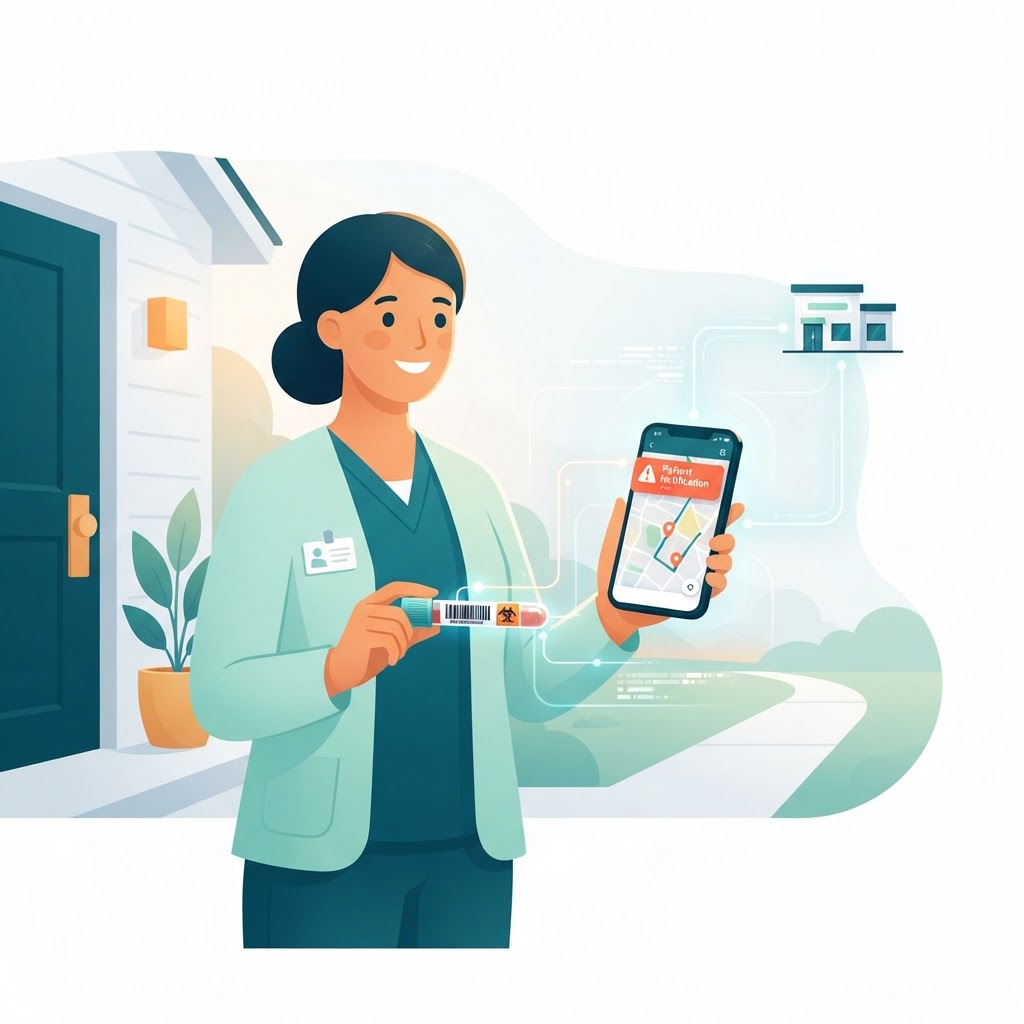

For many patients, the hardest part of a blood test is not the needle. It is the travel, the waiting room, the half-day lost from work, and the logistics of getting an elderly parent to a lab on an empty stomach. Home sample collection fixes this by sending a trained phlebotomist to the patient’s doorstep. But behind that simple idea sits a surprisingly complex operation: booking, scheduling, routing, sample tracking, payments, and timely report delivery. This is where home sample collection software earns its place.
If your lab already runs a LIMS, home collection is one of the workflows that extends it beyond the lab walls. In this article, we break down what home sample collection software does, how it fits into your laboratory workflow, and what to look for when choosing or building a system.
What Is Home Sample Collection?
Home sample collection is a service where a diagnostic laboratory sends a phlebotomist or trained collection agent to a patient’s home, office, or care facility to collect blood, urine, or other biological samples. The sample is then transported to the lab for processing, and the report is delivered to the patient digitally or in print.
The service has grown rapidly in India, driven by patient demand for convenience, the rise of health checkup packages, and competitive pressure among diagnostic chains. For labs, home collection expands reach beyond the physical lab location and captures patients who would otherwise delay or skip testing.
However, running home collection at scale creates operational challenges that phone calls and spreadsheets cannot solve efficiently:
- Scheduling: Matching phlebotomists to patient locations within time windows
- Sample integrity: Keeping samples stable during transport with proper temperature and labeling
- Communication: Confirming bookings, sending reminders, and notifying patients when the collector is on the way
- Tracking: Knowing which samples have been collected, which are in transit, and which have reached the lab
- Compliance: Maintaining chain of custody and patient data privacy
The Home Collection Workflow
A typical home sample collection follows these stages. Good software supports each one:
| Stage | What Happens | What Software Does |
|---|---|---|
| 1. Booking | Patient requests a test by phone, app, or website | Captures patient details, test list, address, preferred slot |
| 2. Confirmation | Lab confirms availability and sends details | Sends automated WhatsApp/SMS confirmation with instructions |
| 3. Scheduling & Routing | Phlebotomist is assigned and a route is planned | Optimizes routes by location, groups nearby visits, accounts for fasting requirements |
| 4. Collection | Phlebotomist visits, collects sample, labels it | Mobile app generates barcode labels, captures collection time, patient confirmation |
| 5. Transport | Sample is carried to the lab | Tracks sample status in transit, flags delays that could affect sample viability |
| 6. Processing | Lab receives and processes the sample | LIMS matches the barcode to the test order, processes the sample |
| 7. Report Delivery | Report is generated and sent to patient | Delivers report via WhatsApp, email, or patient portal |
Key Features of Home Sample Collection Software
Online Booking and Scheduling
Patients should be able to book a home collection through a website, mobile app, or even a WhatsApp chatbot. The system needs to capture:
- Patient name, age, and gender (as they should appear on the report)
- The specific tests or health package prescribed
- Collection address with landmark and pincode
- Preferred date and time window
- Preparation instructions (fasting, medication hold, etc.)
A well-designed booking flow also checks whether the pincode falls within the lab’s service area before confirming a slot. Booking a collection that the lab cannot serve creates a broken promise and a lost patient.
Route Optimization
If a phlebotomist is visiting eight patients across a city, the order of those visits matters. Route optimization software calculates the most efficient sequence based on patient locations, time windows, and traffic patterns. This reduces travel time, fuel costs, and patient waiting.
Labs that handle this manually by glancing at a map and a list typically run 20 to 30 percent more travel time than an optimized route. The software also adapts in real time: if a visit takes longer than expected, the system updates the ETA for remaining patients automatically.
Phlebotomist Mobile App
The phlebotomist’s mobile app is the operational backbone of home collection. It should provide:
- The day’s visit list with patient details, tests, and address
- Turn-by-turn navigation to each location
- Barcode or QR code generation for sample labeling at the point of collection
- A status update for each visit: collected, patient not home, rescheduled, or cancelled
- A photo capture for prescriptions or consent forms
- Payment collection (UPI, cash, or prepaid confirmation)
When the phlebotomist marks a sample as collected and scans the barcode, that information flows instantly back to the lab’s LIMS. The sample is already in the system by the time it arrives at the lab’s receiving counter.
Barcode and Sample Tracking
Every sample collected at home needs a unique identifier, typically a barcode label generated at the point of collection. This barcode ties the physical tube to the patient’s test order in the LIMS. As the sample moves from the patient’s home to the transport bag to the lab’s accession counter, each scan records where it is and when it arrived.
This chain of custody matters for two reasons. First, it prevents sample mix-ups, which are among the most dangerous errors in laboratory medicine. Second, it supports compliance with standards like ISO 15189, which requires laboratories to trace samples through the entire examination process. You can read more about how samples travel through the lab in our sample lifecycle guide.
Real-Time Patient Tracking and Notifications
Patients want to know when the collector is coming. The most common question a lab front desk answers is: “When will someone arrive?” Software eliminates this question by sending automated notifications:
- Booking confirmation with date, time window, and preparation instructions
- Evening-before reminder with the next day’s slot and instructions
- On-the-way alert with an estimated arrival time
- Report ready notification with a link to the digital report
These notifications, typically sent via WhatsApp or SMS, reduce inbound calls, improve patient satisfaction, and lower no-show rates. For labs that also offer online report delivery, the final notification closes the loop from booking to report in a single connected flow.
Payment Processing
Home collection payments happen in three modes: prepaid at booking, UPI or card at the time of collection, or cash to the phlebotomist. Software should support all three and reconcile payments against the test order. Prepaid and digital payments reduce cash-handling errors and eliminate the need for the phlebotomist to carry change.
Compliance and Data Privacy
Home collection involves handling sensitive patient data: names, addresses, phone numbers, test prescriptions, and health reports. In India, the Digital Personal Data Protection (DPDP) Act, 2023 establishes obligations for entities that process personal data digitally. Diagnostic labs that collect and store patient information for home collection fall within the scope of this Act.
Practical compliance measures include:
- Collecting only the patient data needed for the collection and report
- Restricting access to patient addresses and phone numbers to the assigned phlebotomist, not the entire collection team
- Storing data in encrypted databases rather than shared spreadsheets or open WhatsApp groups
- Retaining data only as long as needed for clinical and regulatory purposes
NABL-accredited labs must also follow ISO 15189 requirements for the pre-analytical phase, which includes sample collection. These cover sample identification, labeling, transport conditions, and documentation. Home collection software that generates barcode labels and records chain of custody supports these requirements directly. You can read more about NABL accreditation and lab software in our dedicated guide.
Benefits for Labs and Patients
For Patients
- No travel or waiting room time
- Fasting samples collected early morning at home
- Elderly and bedridden patients served without disruption
- Digital report delivery, no return visit needed
For Labs
- Expanded service area without new collection centres
- Higher test volume from patients who would otherwise delay testing
- Fewer front-desk calls due to automated notifications
- Better sample traceability through barcode tracking
- Cleaner data for compliance audits
Common Challenges and How Software Addresses Them
Missed visits. A phlebotomist arrives and the patient is not home. Software sends an automated reminder the evening before and a second alert when the collector is en route. The system logs the outcome and triggers a rescheduling callback.
Sample mix-ups. Manual labeling with handwritten patient names leads to errors. Barcode generation at the point of collection, tied to the LIMS test order, eliminates this risk.
Route inefficiency. Assigning visits by gut feel wastes time. Route optimization algorithms plan the shortest path through all stops and adjust dynamically.
Payment gaps. Cash collection without digital reconciliation leads to discrepancies. Integrated payment tracking matches every collected amount to the test order.
Data exposure. Sharing patient addresses and test details in large WhatsApp groups exposes sensitive information. A dedicated phlebotomist app shows each collector only their own assigned visits.
How IdLabNet Supports Home Collection
IdLabNet, Ideativemind’s laboratory information management system, integrates home sample collection into the broader lab workflow. Phlebotomists can collect samples with mobile-generated barcodes that sync directly with the LIMS, ensuring every sample is tracked from the patient’s doorstep to the report. The system also handles booking management, route planning, and patient notifications, so labs can run home collection as a connected part of their daily operations rather than a separate manual process.
If you want to see how IdLabNet can work for your lab’s home collection needs, get in touch with us.
Conclusion
Home sample collection is no longer a value-add service for diagnostic labs. It is an expectation. Patients compare labs on convenience as much as on price or report speed. The labs that win are the ones whose home collection runs smoothly: accurate bookings, on-time arrivals, properly labeled samples, and fast digital reports.
Software is what makes this possible at scale. From the booking screen on a patient’s phone to the barcode scanner in the lab, every step in the chain benefits from automation. If your lab is still managing home collection with phone calls and spreadsheets, the gap between your operation and a software-driven one is visible to your patients every day.

 By
By