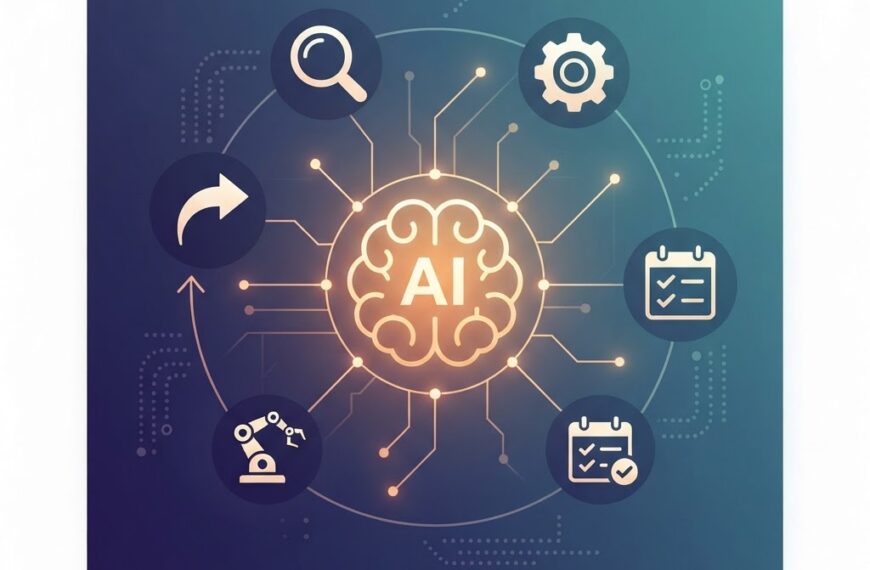

AI agents are software systems that perceive their environment, reason about what to do next, and take actions to achieve a goal. That sentence covers a lot of ground. In this article, we break down the actual architecture behind an AI agent — the components, how they connect, and how the whole system loops through perception, reasoning, and action.
If you are new to the concept, start with our earlier plain-English guide to AI agents and our comparison of AI agents vs chatbots. This article goes one level deeper into the moving parts.
What Is an AI Agent Architecture?
An architecture, in software terms, is the structure that defines how components interact. For AI agents, that means specifying how the model, memory, tools, and decision-making logic fit together.
The foundational definition comes from Stuart Russell and Peter Norvig in their textbook Artificial Intelligence: A Modern Approach, where they describe an agent as anything that perceives its environment through sensors and acts upon it through actuators. That definition was written long before large language models (LLMs), but it still holds. What has changed is the “brain” — modern agents use LLMs as their reasoning engine.
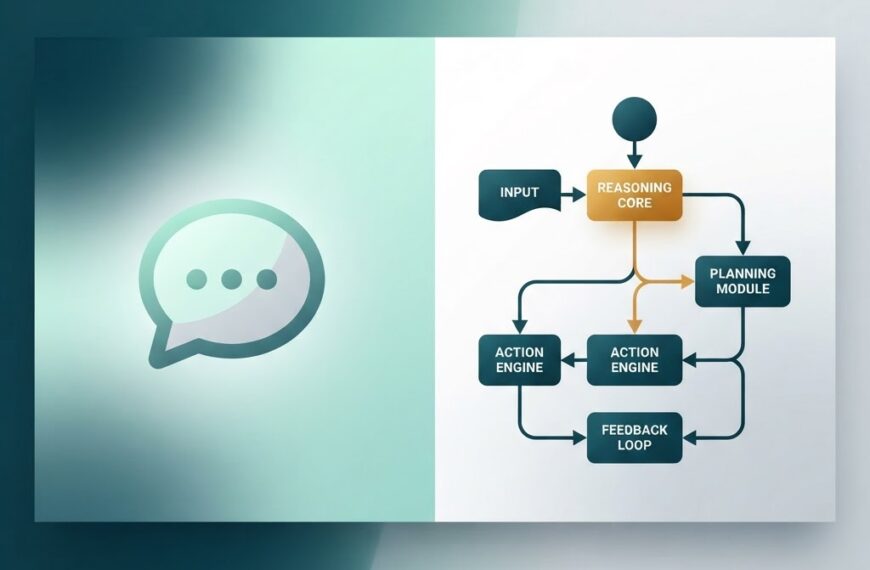
The Core Components of an AI Agent
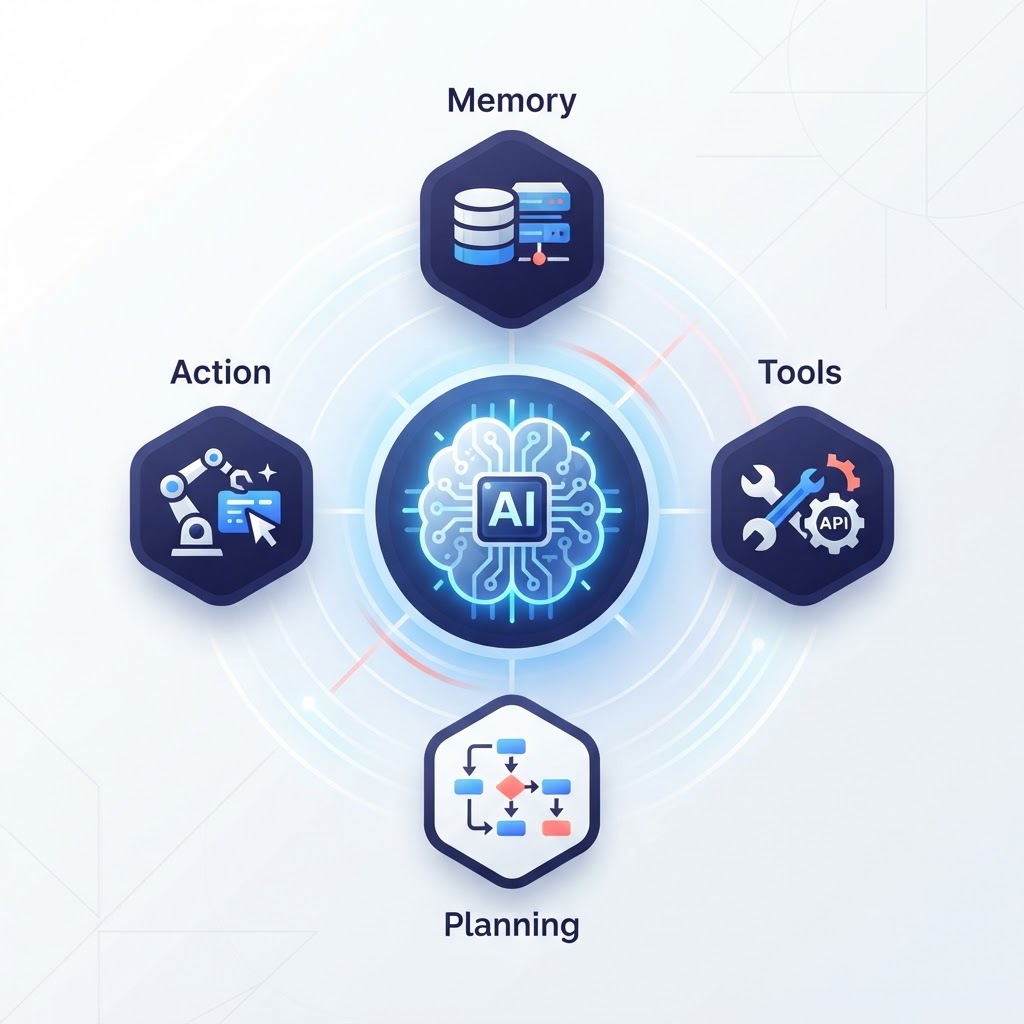
A production AI agent typically has five building blocks. Each one handles a distinct job.
The Language Model (The Brain)
The core of a modern AI agent is a large language model. This is the component that reads instructions, interprets context, reasons through problems, and decides what to do next. Common models include OpenAI’s GPT series, Anthropic’s Claude, Google’s Gemini, and open-source alternatives like Meta’s Llama.
The model does not store data permanently or perform actions on its own. It processes text in and produces text out. Everything else in the architecture exists to give the model useful inputs and carry out the decisions it makes.
Memory Systems
Without memory, an agent would start every interaction from scratch. Memory in agents comes in two forms:
- Short-term memory — this is the context window of the language model. Everything in the current conversation, tool outputs, and interim reasoning steps lives here. It has a strict size limit, which varies by model.
- Long-term memory — this uses external storage, typically a vector database. When the agent needs information from past sessions, it retrieves relevant chunks by semantic similarity and inserts them into the context window. This is how an agent can “remember” facts across days, weeks, or months.
| Memory Type | Where It Lives | Capacity | Typical Use |
|---|---|---|---|
| Short-term | Model context window | Limited (e.g., 8K–200K tokens) | Current task, recent tool outputs |
| Long-term | Vector database (e.g., Pinecone, Weaviate) | Scalable | Past conversations, learned preferences, knowledge base |
Tool Use and APIs
A language model alone cannot send an email, query a database, or browse a web page. Agents bridge this gap with tools — functions or API endpoints the model can call. When the model decides it needs information or action beyond text generation, it outputs a structured request asking a specific tool to run.
Common tools include:
- Web search and browsing
- Database queries (SQL or NoSQL)
- Email and calendar APIs
- Code execution sandboxes
- File read/write operations
The architecture defines which tools are available, how the model calls them, and how results come back into the context.
Planning and Reasoning
This is where the agent decides its course of action. Several approaches exist, and they are not mutually exclusive:
- Chain-of-Thought (CoT) — the model writes out its reasoning steps before giving a final answer. This improves accuracy on multi-step problems.
- ReAct — short for Reasoning and Acting, this framework combines thinking and tool-calling in a loop. The model reasons about the task, calls a tool, observes the result, then reasons again. The approach was described by Yao et al. in 2022 (arXiv:2210.03629) and has become one of the most widely adopted agent patterns.
- Plan-and-Execute — the agent first generates a full multi-step plan, then executes each step sequentially or in parallel. This works well for complex, well-defined tasks but can be brittle if early assumptions are wrong.
Action Execution
Once the model decides what to do, the action execution layer carries it out. This might mean calling an API, running a script, writing to a file, or sending a message. The results of the action are fed back into the agent’s context so the model can decide what to do next.
The Agent Loop: Perceive, Think, Act
All these components connect through a simple but powerful cycle:
- Perceive — the agent receives an input: a user message, a scheduled trigger, or a sensor reading.
- Think — the model reasons about the input, consults memory, and plans a response or action.
- Act — the agent calls tools, executes code, or generates text.
- Observe — tool outputs and results return into the context.
- Repeat — the agent evaluates whether the goal is met. If yes, it responds. If not, it loops back to thinking.
This cycle is sometimes called the agent loop or observe-orient-decide-act (OODA) loop, borrowing from military strategy. The key insight is that the agent does not just answer a question — it iterates toward a goal.
Types of AI Agent Architectures
Not all agents are structured the same way. Three common patterns have emerged in practice:
Single-Agent
One model, one set of tools, one loop. This is the simplest architecture and the one most people encounter first. An example is a chat assistant that can search the web and answer questions. It handles one task at a time and works well for most individual use cases.
Multi-Agent Systems
Multiple agents work together, each with a specialized role. One agent might focus on research, another on writing, a third on quality review. They communicate by passing messages or sharing a workspace. Multi-agent systems can tackle complex workflows that exceed what a single agent can handle, but they add coordination overhead and are harder to debug.
Hierarchical Agents
A top-level “orchestrator” agent decomposes a large task into subtasks and assigns them to worker agents. Workers handle their piece and report results back up. This mirrors how human organizations work — a manager breaks a project into tasks, assigns them, and synthesizes the results.
| Architecture | Best For | Complexity | Example |
|---|---|---|---|
| Single-agent | Focused tasks, Q&A, simple automation | Low | Web-search-enabled chatbot |
| Multi-agent | Collaborative workflows, role specialization | Medium-High | Research + writing + review pipeline |
| Hierarchical | Large projects with clear subtask decomposition | High | Project orchestrator with worker agents |
How Memory Actually Works in Practice
Memory is often the most overlooked part of agent architecture, yet it determines whether an agent feels intelligent or forgetful.
Short-term memory is simply the sequence of messages and tool outputs in the current session. When the context fills up, older messages may be truncated or summarized. Some systems use sliding windows, keeping only the most recent N messages in full and summarizing the rest.
Long-term memory requires a retrieval mechanism. The most common approach:
- Text from past interactions is split into chunks.
- Each chunk is converted into a vector embedding using an embedding model.
- Vectors are stored in a vector database.
- When the agent processes a new input, it embeds the query and searches the database for similar chunks.
- The retrieved chunks are inserted into the context window as relevant background.
This is essentially how retrieval-augmented generation (RAG) works, and it is the backbone of persistent agent memory.
Challenges and Real-World Considerations
Building a reliable AI agent is harder than it sounds. Several issues recur in practice:
- Hallucination — the model may confidently state incorrect information. Grounding with tool results and verified sources mitigates this.
- Loops and dead ends — an agent may call the same tool repeatedly without making progress. Well-designed systems include loop detection and maximum step limits.
- Context overflow — long sessions can exceed the model’s context window. Summarization and selective retrieval help manage this.
- Cost — each reasoning step and tool call consumes tokens. Complex agent loops can become expensive, so architecture decisions should balance capability and cost.
- Safety and permissions — agents that can take actions (send emails, modify data) need guardrails. Most production systems require human approval for sensitive actions and limit the scope of what each agent can do.
Where This Is Heading
Agent architectures are evolving rapidly. Open-source frameworks like LangChain, AutoGPT, and CrewAI have made it easier to build multi-step agents. Major model providers are building tool-calling capabilities directly into their APIs, reducing the need for custom orchestration layers.
For businesses, the practical takeaway is that AI agents are not magic. They are systems with clear, understandable components — a model, memory, tools, a planning method, and an execution layer. Understanding this architecture helps you evaluate what agents can realistically do and where they need human oversight.
If you want to explore how AI can be embedded in business software, see how Ideativemind uses AI in client operations or learn about our IdLabNet LIMS platform, which applies these principles in diagnostic laboratories. Get in touch if you have a project in mind.

 By
By